
Clay Alternatives in 2026: When a Tool Isn't the Answer
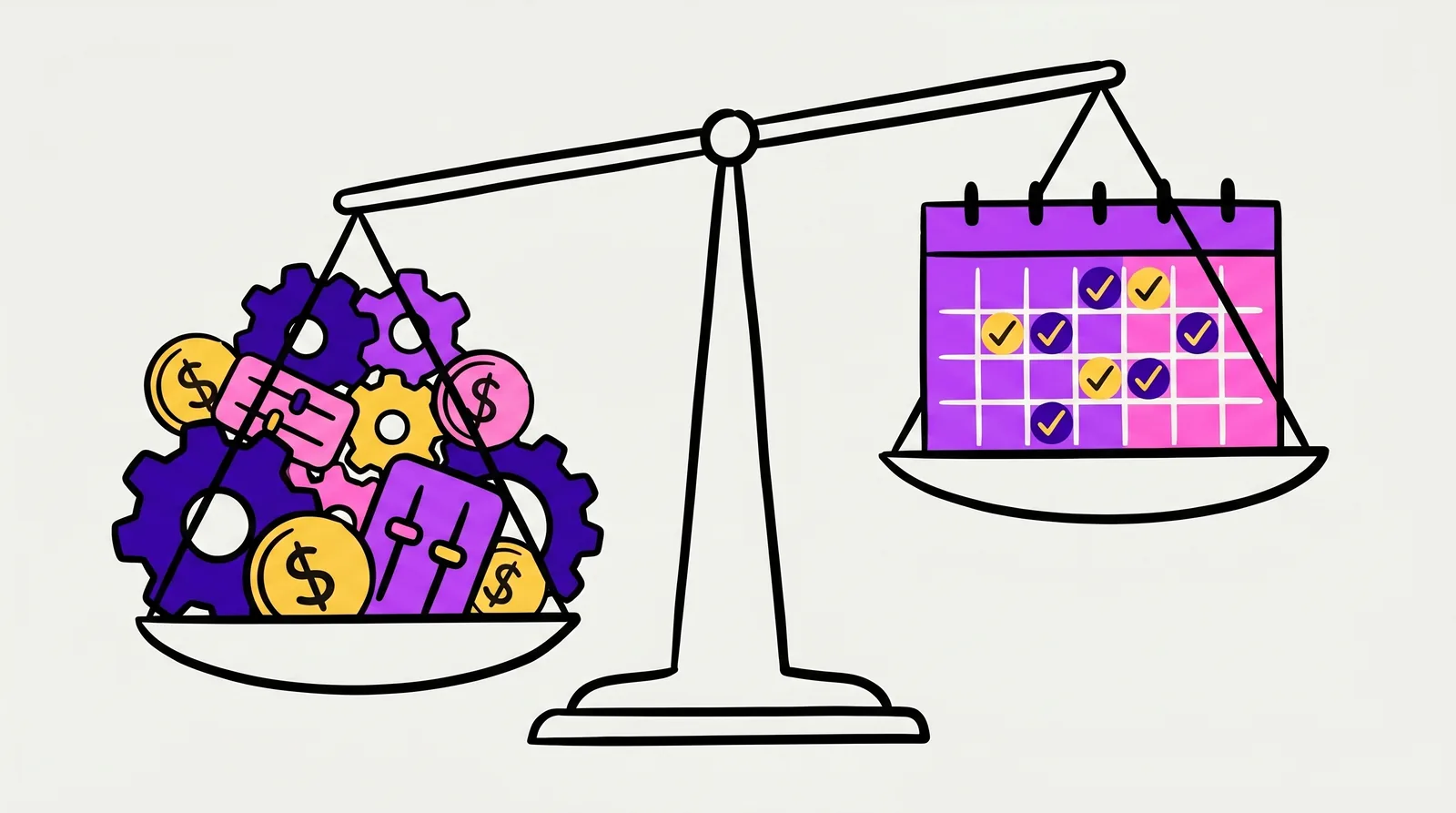
The best Clay alternatives in 2026 come in two flavors: other data-and-sending tools - Apollo, ZoomInfo, Cognism, Lemlist, Smartlead, and Warmly - that each beat Clay at one specific job, and done-for-you services that run the entire outbound motion for you. Which one fits comes down to a single question: do you want to operate the machine, or just get the meetings?
Clay is a genuinely powerful tool. But powerful and right-for-you are not the same thing - and the moment your credit bill clears four figures, or you realize you have hired someone mostly to babysit workflows, it is worth asking what you are really shopping for. Below, we compare the strongest alternatives honestly, run the actual cost math, and name the option most listicles quietly skip.
Why teams look for a Clay alternative
First, what Clay actually is: a data-enrichment and workflow-automation engine, not a data provider. It connects to 150+ third-party sources and runs waterfall enrichment - querying providers one after another until one returns a match - then layers on AI research through its agent, Claygent. For a technical operator who wants granular control, it is a Swiss Army knife.
The catch is baked into that same description, and it shows up as three recurring frustrations:
- Unpredictable, credit-based cost. Clay meters every enrichment action in credits, and real spend climbs fast - growing teams routinely report $800 to $4,000 a month once volume and AI steps ramp up. After Clay's March 2026 pricing overhaul, paid plans run roughly $185 (Launch) to $495 (Growth) on a new dual-meter model of Data Credits plus Actions, with enterprise above that. The sticker price is rarely the real price.
- A steep learning curve. Most users need hours to weeks before they are building workflows that pay off. Clay rewards patience and spreadsheet-style logic; it punishes anyone expecting plug-and-play.
- It owns no data, and it does not send. Match quality depends entirely on the providers you connect (premium ones like ZoomInfo cost extra on top), and Clay stops at the data layer - you still export to a separate tool to actually send. The reviews split along these lines: power users rate it highly on G2, while its Trustpilot score sits around 2.5 out of 5.
The best Clay alternatives, compared
Clay's job really splits into three pieces: find the right people, get accurate contact data, and eventually reach them. Most alternatives simply do one of those jobs better for a given team. Here is how the leading options stack up.
| Alternative | Best for (and rough pricing) |
|---|---|
| Apollo.io | All-in-one prospecting plus built-in sending; free tier, paid from about $49 per user per month; low learning curve |
| ZoomInfo | The deepest, most accurate enterprise B2B data; annual, sales-led pricing |
| Cognism | Compliant data with phone-verified mobiles, strong in the EU and UK; annual, sales-led |
| Lemlist | Multichannel sequences (email plus LinkedIn) with a built-in lead database; from about $59 per month |
| Smartlead / Instantly | High-volume sending and deliverability when you already have data; from about $30 to $40 per month |
| Warmly / Common Room | Surfacing buying signals so outbound lands warmer; free tier, scales with use |
The honest read on those tools
If your problem is one specific shortcoming - cost, sending, compliance, or data depth - one of these tools fixes it. Apollo is the practical all-in-one when you want fewer tools and a predictable per-seat bill. ZoomInfo and Cognism win on data depth and compliance. Smartlead and Instantly are senders, not data tools, for when your gap is getting to the inbox at volume. Warmly and Common Room add buying signals on top.
But notice that every one of these options still leaves you operating software. That assumption is the one worth questioning - and the cost math below is why.
The cost math: what a usable lead actually costs in Clay
Here is the part the per-credit sticker price hides. Clay charges credits per enrichment action, so the cost of a lead depends entirely on how much you do to it - and a usable lead (qualified, verified, personalized, ready to contact) takes a lot of steps. Credit rates vary by plan, so treat the dollars as directional.
Light touch first. If you only run basic enrichment, an email finder, and verification, you will spend roughly 5 to 10 credits per lead, or about $100 to $300 per 1,000 leads. Cheap, but you get a raw contact, not a qualified, personalized lead that is ready to send. You still do everything else yourself.
Now the full pipeline - everything a managed service does automatically. To match it (data scraping, LinkedIn and website enrichment, AI qualification, email finding, verification, and AI personalization), the credit-burning steps stack up. A realistic campaign that sources 75,000 profiles to net 10,000 contactable leads looks like this:
| Clay step (per campaign) | Credits |
|---|---|
| LinkedIn enrichment (75,000 x 1) | 75,000 |
| Website enrichment (75,000 x 1) | 75,000 |
| AI qualification (75,000 x 1) | 75,000 |
| Email finder (10,000 x 3) | 30,000 |
| Email verification (10,000 x 1) | 10,000 |
| AI personalization (10,000 x 15) | 150,000 |
| Total to net 10,000 contactable leads | 415,000 |

$0.55 a lead, before you send anything
That campaign is about 41.5 credits per contactable lead. At roughly $2,000 per 150,000 credits (a typical higher-volume rate; your plan may differ), it runs about $5,500, or $0.55 per lead - and it burns through nearly three months of a 150,000-credit monthly quota in one go. AI personalization alone, at 15 credits a lead, is about 36% of the bill.
Hold onto that number: $0.55 for the data work on a single usable lead, before you have sent a single email, paid for a sender, or hired anyone to run it.
The alternative nobody lists: a done-for-you service
Every other Clay alternatives article quietly assumes you will keep operating a tool - it just swaps which one. The option none of them mention is the one a lot of teams actually want once they are tired of the machinery: do not operate a tool at all. Hand outbound to a service that runs it for you and delivers booked meetings.
This is a different category, not a cheaper tool. A done-for-you service like Ken owns the entire stack you would otherwise assemble and babysit. Look back at that Clay credit breakdown - LinkedIn and website data, AI qualification, email finding, triple verification, AI personalization. Every one of those lines is something Ken does automatically, included. As Ken's own FAQ puts it: no Instantly, no Clay, no ScaledMail, it is all built in.
And the numbers Ken reports are the kind a raw tool cannot promise, because a tool hands you data, not outcomes: a 3% reply rate against a 0.8% industry average, around 7 booked meetings per 10,000 contacts, and roughly 25% more replies than tools like Instantly and Smartlead across 1.2 million emails tested. You are buying a result, not a workflow.
| Clay (a tool: data work only) | Ken (done-for-you service) |
|---|---|
| About $0.55 per contactable lead, in credits | About $0.35 per contact all-in, and less as you scale |
| Covers data, enrichment, AI qualification, and personalization | Covers all of that, plus human copy, 5-email sequences, and replies |
| You still buy and run a sender, warmup, and inboxes | Sending, premium warmup, domains, and inboxes included |
| You staff the operator and the follow-up | A real team runs it; about 70% of replies handled automatically |
| Weeks of setup and a learning curve | Live in about two weeks, with nothing to learn |

What Ken actually costs (and why it can beat Clay)
Ken's pricing is a flat monthly retainer plus a per-contact fee that falls from $100 to $70 per 1,000 as you scale. Run the blend at a typical entry volume and it lands around $0.35 per contact, dropping toward $0.10 at higher volume - and that single number already covers the data, the AI, the human copy, the sending infrastructure, deliverability, and the people running it.
Put plainly: the all-in managed price comes in near what Clay charges for the data alone. You are not paying more to hand off the work - you are often paying less, and getting the entire downstream operation thrown in.
So which Clay alternative is right for you?
Strip away the logos and it is a short decision. Pick the path that matches your team, not the one with the lowest sticker price.
- Do you have someone to operate it? No in-house operator points to a service; a dedicated RevOps person makes a tool viable.
- Is your bottleneck data, sending, or time? Data depth points to ZoomInfo or Cognism; sending and deliverability to Smartlead or Instantly; time and headcount to a done-for-you service.
- How predictable does cost need to be? If a credit meter swinging $800 to $4,000 a month is a problem, avoid usage-metered tools and pick flat-rate software or a fixed managed service.
- How fast do you need meetings? Tools carry a setup-and-learning ramp; a managed service is built to reach first meetings without you climbing it.
- Is outbound a skill you want to own, or an outcome you want to buy? That is the real fork in the road. Everything else is detail.
Frequently asked questions
Is Clay worth it? For a technical GTM or RevOps team with someone to build and maintain workflows, yes - it is powerful and flexible. But it has a steep learning curve and credit costs that can reach $800 to $4,000 a month at scale. Without a dedicated operator, a simpler tool or a managed service usually delivers meetings faster.
How much does Clay cost per lead? It depends on how much enrichment you run. A light touch (basic data, an email finder, and verification) is about 5 to 10 credits per lead, or $100 to $300 per 1,000. A full pipeline that qualifies, verifies, and personalizes each lead runs about 40 credits per lead, near $0.55 each or about $550 per 1,000, before you send a single email.
What is the cheapest Clay alternative? For a tool, Apollo.io has a free tier and paid plans from about $49 per user per month, and senders like Smartlead and Instantly start near $30 to $40 a month. But cheapest by sticker price is misleading: once you add an operator's time, premium data, and a sending stack, a flat-rate platform or a managed service is often cheaper per booked meeting.
Do I need Clay if I hire an agency? No. A done-for-you service like Ken already includes everything Clay would sit inside - list-building, enrichment, copy, deliverability, and replies. Paying for Clay on top means operating a tool the agency already runs for you.
Clay versus done-for-you outreach: which gets results faster? Done-for-you is usually faster to first meetings because there is no setup or learning curve - an experienced team runs proven infrastructure from day one. Clay can match it on control, but only after the weeks it takes to master the platform and wire up a sender.
See what done-for-you actually looks like
If you have read this far, you are not really shopping for a tool - you are shopping for booked meetings. That is the whole point of a managed service: you define your ideal customer, and someone else runs the machine.
Book a founder call with Cristian at cal.com/cristian-frunze/demo. You will see the backend, the data, and the cases closest to your ICP. If it is not the right fit, we will tell you what else to try.