
Cold Email Agency: The Complete Guide to Done-for-You Outreach (2026)
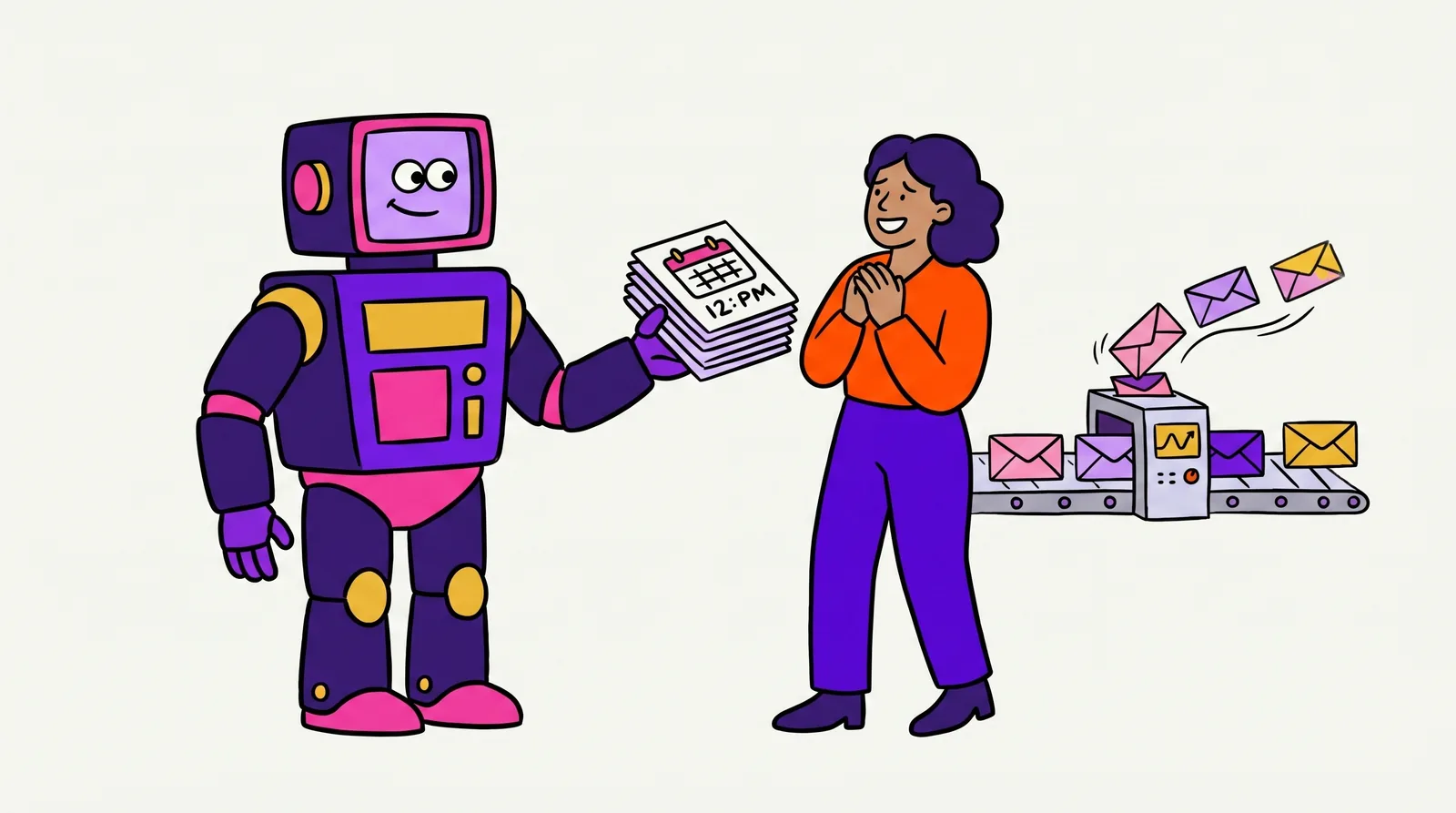
A cold email agency runs your B2B outbound email program for you - defining your ideal customer, building and verifying the prospect list, writing and personalizing the emails, owning the sending infrastructure and deliverability, and handling the replies - so your team gets booked meetings instead of doing the work. The best ones operate as a fully managed system, not a tool you have to learn.
If you are researching cold email agencies, you are really weighing four paths: keep wrestling with DIY sending tools, trust an AI SDR to do it all, hire and ramp an in-house SDR, or hand the whole motion to a specialist. This guide covers what a cold email agency actually does, why outsourcing it usually beats doing it yourself, what it costs, and how to choose one without getting burned. We run Ken AI, a done-for-you cold email agency, so we will use our own setup as a concrete example of what good looks like - and we will be honest about when an agency is the wrong call.
What a cold email agency actually does
A good agency runs a complete outbound system. Most of the work is invisible to you, which is the point. Here is what is happening under the hood, with examples of what we do at Ken at each step:
- List building. It starts with a precise ideal customer profile, and the best agencies treat your ICP as several segments, not one. We segment an ICP into as many as 10 audiences, source matches from a 300M+ contact database across 20+ data platforms, and qualify on subjective criteria no Sales Navigator filter can handle - like B2B SaaS with pricing above $3k. Every email is triple-verified, filtering out roughly 78% of risky or invalid addresses before a single send.
- Infrastructure and deliverability. Top agencies do not send from your primary domain or shared tool infrastructure. We built our own email servers on dedicated IPs (not Gmail or Outlook), warm inboxes on a private network, and run every message through a replicated Gmail spam algorithm that rewrites anything likely to be filtered - which is how we hold 80%+ inbox placement while most senders struggle to crack 50%.
- Copywriting and personalization. Human copywriters build the frameworks and QA the output, while AI is trained to replicate that voice for each individual prospect, referencing real details from their world rather than swapping a first-name variable. A CFO should get a genuinely different email than a Head of Sales.
- Sending and deliverability management. Campaigns send at controlled volumes across warmed inboxes, monitored with tools like Microsoft SNDS and Google Postmaster. When a domain or inbox gets flagged, we swap to backups within hours so your volume never drops.
- Reply handling and meeting booking. Replies get triaged: genuine interest is qualified and booked, while out-of-office and not-interested are filtered. You get warm conversations, not a raw inbox to sort.
- Reporting and optimization. You get live reporting and continuous A/B testing - and every tracked click can feed your retargeting audiences, so cold email becomes the top of a full funnel, not just the inbox.

Why hire an agency instead of doing it yourself?
Here is the core problem. Cold email has always forced a trade-off between four things: scale, relevance, cost, and personalization. Do it manually and you get relevance with no scale. Automate it with a tool and you get scale but generic, irrelevant blasts. The way we say it at Ken: pick two, lose two. A real agency is built to deliver all four at once, because it pairs a software engine for scale and cost with human strategists for relevance and personalization.
When you try to solve outbound yourself, you usually fall into one of three buckets - and each one breaks in a predictable way:
- The DIY tool stack. Instantly or Smartlead for sending, a separate provider for infrastructure, Clay or Apollo for data. You become the integrator, the copywriter, the deliverability engineer, and the analyst - sending on shared infrastructure you compete for inbox space on, next to the spammers. Most teams running this stack plateau near a 1% reply rate and assume that is normal.
- The AI SDR. Software that promises to replace your sales team: plug in an ICP and let the AI write and send everything. It scales, but with no human owning relevance or quality, it produces exactly the generic mail that gets filtered and ignored.
- The in-house SDR. The right long game if you are building a sales org - but one SDR is fully loaded at well over $100k a year once you add salary, benefits, tools, and management, takes two to four months to ramp, and is usually learning deliverability on your domain's reputation.
What you actually get from an agency
An agency fixes all three at once because it does only this, all day, with infrastructure and a team that no single hire or tool gives you:
- A whole team, not a seat. GTM strategists, human copywriters, and dedicated deliverability engineers whose entire job is fixing inbox issues before they hit you - for less than the loaded cost of one SDR.
- Infrastructure you could never justify building alone. Owned servers, dedicated IPs, a private warmup network, automatic spam-filter rewriting, and always-ready backup domains.
- Speed to value. A specialist launches in about two weeks; an in-house build takes months and a tool stack takes weeks of your own time just to configure.
- Your domain stays protected. Sending happens on alternative domains that mirror your brand, so your primary domain reputation is never at risk.
Agency vs. tools vs. AI SDR vs. in-house SDR
The honest summary: tools are cheapest on paper and most expensive in practice, because the hidden cost is a skilled person running them 15 to 25 hours a week. An in-house SDR is right only if you are committed to building the function. An agency wins on time-to-value and specialization. Here is how the four options compare:
| Your option | What you are really signing up for |
|---|---|
| DIY tools (Instantly, Smartlead, Clay) | Cheap software, but you become the integrator, copywriter, deliverability engineer, and analyst - most teams plateau near a 1% reply rate. |
| AI SDR | Scales sending with no human owning quality, so it produces the generic mail that gets filtered and ignored. |
| In-house SDR | $8k to $12k+ a month fully loaded, two to four months to ramp, and learning deliverability on your own domain. |
| Cold email agency | A managed team plus owned infrastructure that delivers booked meetings in about two weeks. You approve; they run it. |
What separates a great cold email agency
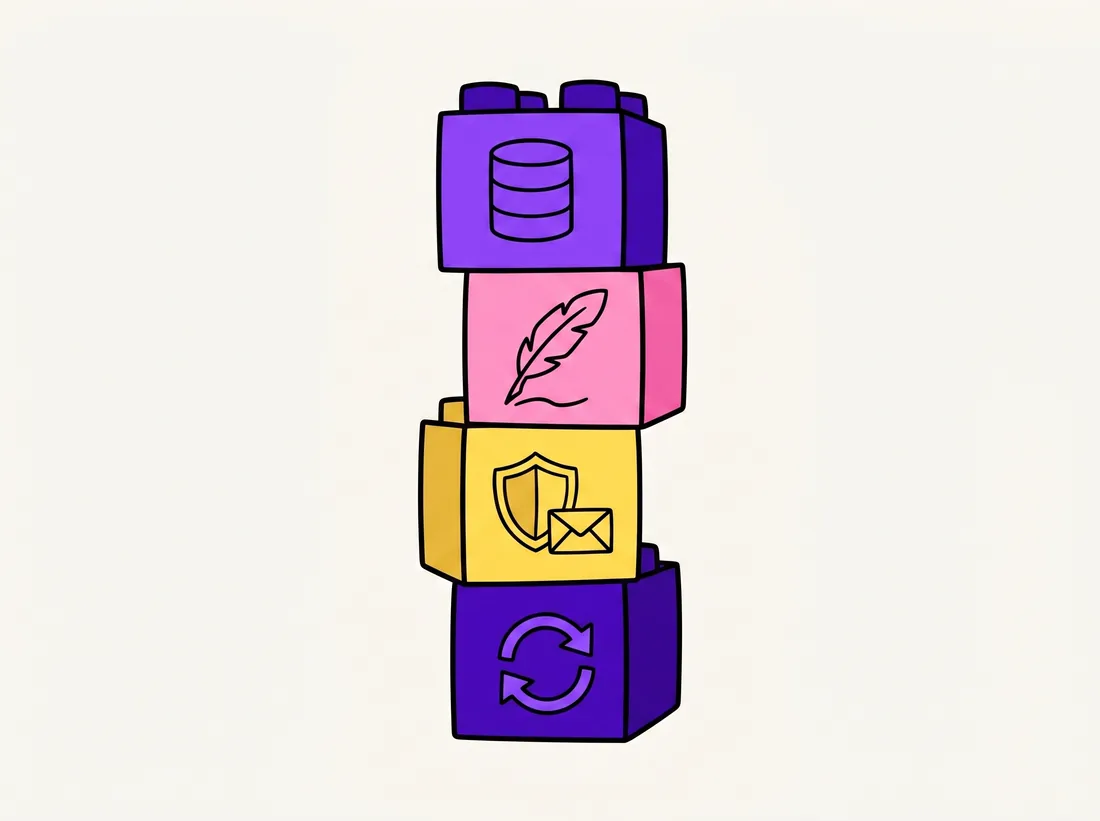
Not all agencies are equal. Many are the traditional kind: grab an Apollo list, send a ChatGPT email, hope something sticks. Use these four pillars - the framework Ken is built on - to tell a real operator from a list-and-pray shop:
- Data depth and qualification. A large, multi-source database (we use 300M+ contacts from 20+ platforms) plus AI qualification on the subjective criteria that actually define your buyer - not just job title and industry. Verification matters as much as volume; we filter roughly 78% of risky addresses before sending.
- Human-led messaging, AI-scaled. The agencies that get replies start with human copywriters who build the strategy and frameworks, then use AI to replicate that voice for every prospect, with humans reviewing at each stage. The test: does each email reference something real about the prospect, or is it a variable swap dressed up as personalization?
- Owned infrastructure. The biggest differentiator and the hardest to fake. Proprietary servers on dedicated IPs, a private warmup network, automatic spam-filter pre-checks, and backup domains. Our infrastructure delivers about 25% better than Gmail or Outlook and holds 80%+ inbox placement. Always ask an agency exactly where your email is sent from.
- Disciplined iteration. Great agencies treat every campaign as a test, and the order matters: offer first, then audience, then messaging. We run 2 to 10 audience segments and 10 to 50 campaigns a month, implement feedback in hours, and after about three months of optimization our campaigns outperform 95% of all cold email sent. Per-segment analytics, not blended averages, are the tell that an agency actually does this.
What results can you expect?
Set expectations with real benchmarks. Industry-wide, cold email reply rates typically land around 1 to 5%, and the gap between a list-and-pray stack and a well-run agency is large. A few realities hold no matter who you hire: it is a medium-term channel, so expect your first campaign live in about two weeks and momentum building over two to three months; list and copy quality beat raw volume every time; and positive-reply rate, not raw reply rate, is the number that matters. As a real-world reference, here is what we report at Ken across 10M+ emails sent in 2025 for 40+ B2B companies:
- 4x the reply rate and 7x more meetings than the industry average
- A 3% reply rate with a 30% positive-reply rate (genuine interest, not just any response)
- A 16% click rate and roughly 7 booked meetings per 10,000 contacts
- 80%+ inbox placement, versus the sub-50% many senders see
How much does a cold email agency cost?
Pricing usually falls into four models. The right one depends on whether you value predictability, volume, or pure outcomes:
| Pricing model | How it works (and who it suits) |
|---|---|
| Flat retainer | A fixed monthly fee for a set scope, roughly $2,000 to $10,000 a month. Best for predictable budgeting. |
| Per-prospect / per-lead | You pay for the volume contacted, typically cents per contact. Best for scaling volume efficiently. |
| Pay-per-meeting | You pay per booked meeting, often $100 to $500+ each. Best for buyers who want pure outcome pricing. |
| Performance-linked hybrid | A lower base plus a performance fee. Best for aligning the agency's incentives with your results. |
What Ken AI charges (a real example)
We use a performance-linked hybrid: one flat retainer of about $2,500 a month plus a per-contact fee that scales down as you grow, from roughly $100 to $70 per 1,000 contacts. A representative $3,500 a month plan covers around 10,000 contacts, 50,000 emails, 5 campaigns, 20 sending domains, and up to 1,000 inboxes - with the entire software stack and the team (strategy, copywriting, deliverability engineering, weekly reporting) included. There is no setup fee and no lock-in, so you can pause or cancel anytime.
Loaded honestly, the alternatives cost more. A DIY data-and-enrichment pipeline through a tool like Clay can run roughly $0.55 per contactable lead for the data work alone - before a sending tool or the person operating it - and an in-house SDR runs $100k+ a year. An agency folds the tools, the infrastructure, and the team into one number, and at scale the all-in cost per contact drops into the low tens of cents. Pricing figures here are current as of 2026; confirm specifics with any agency you evaluate.
Questions to ask a cold email agency
Use these questions to separate the specialists from the spray-and-pray crowd:
- Where do you send from? You want dedicated IPs and domains and your primary domain protected, not shared tool infrastructure.
- How do you protect deliverability? Look for dedicated domains, SPF, DKIM and DMARC, private warmup, SNDS and Postmaster monitoring, and backups.
- Where does the data come from, and is it verified? Multi-source, enriched, and triple-verified beats a bought list.
- Who writes the copy, and how human is it? Human frameworks scaled by AI, not pure mail-merge.
- Do you segment, and do you report per segment? Blended averages hide the truth.
- How do you handle replies and book meetings?
- How are you compliant with CAN-SPAM, CASL, GDPR, and CCPA?
Green flags and red flags
Once you have the answers, here is how to read them:
- Green flag: transparent methodology, per-segment analytics, your-domain protection, a human managing campaigns, owned infrastructure, no setup fee, and pause-anytime terms.
- Red flag: guaranteed meeting counts, suspiciously cheap bulk lists, we will just send from your main domain, sending on public warmup networks, no compliance story, and long lock-in contracts.
Is cold email still legal in 2026?
Yes - B2B cold email is legal in the United States under the CAN-SPAM Act, provided you follow the rules: accurate header information, no deceptive subject lines, a valid physical postal address, and a clear, honored opt-out. Other regions add requirements: CASL in Canada, GDPR in the EU and UK (where B2B outreach typically relies on a legitimate-interest basis), and CCPA in California.
A serious agency treats compliance as a core competency, not an afterthought. Ken runs CASL, GDPR, and CCPA-compliant outreach by design, which protects both your brand and your deliverability. This is general information, not legal advice - confirm the specifics for your jurisdiction.
How done-for-you cold email works with Ken AI
Here is what the managed model looks like in practice, and how fast it moves:
- Strategy call and onboarding (week one). You map your ICP and goals; we build the GTM strategy and start warming domains.
- Targeting and sourcing. Your ICP is segmented into audiences; prospects are sourced from a 300M+ database, qualified on the criteria that define a real buyer, and triple-verified.
- Copy and launch (week two). Human copywriters write per-segment frameworks; AI personalizes each email in your voice; you approve, and campaigns go live about two weeks from kickoff.
- Send, monitor, optimize. Email sends from dedicated IPs through a spam-algorithm pre-check; deliverability is monitored and copy is continuously tested.
- Warm conversations delivered. Interested replies are qualified and booked, and engaged clickers feed your retargeting audiences. You get booked meetings, not a to-do list.
Is a cold email agency worth it?
It is worth it when you do not have in-house outbound expertise, you want pipeline without hiring and ramping a team, deliverability feels like a black box, or your team's time is better spent closing than prospecting. As one of our clients, Ryan Allis, founder of SaasRise and a $169M SaaS exit, puts it: any B2B firm with an ACV north of $2k should be doing outbound email, and if you are going to outsource it, Ken AI is a very good option.
It is probably not worth it when you are pre-product-market-fit with no clear ICP, your average contract value is too low to support a sales-led motion, or you are committed to building an in-house SDR function for the long haul.
The honest answer: a cold email agency is the fastest way to turn outbound into a reliable source of meetings, as long as you pick a specialist with owned infrastructure, human-led copy, and the willingness to tell you the truth about what is working.
Frequently asked questions
What is the difference between a cold email agency and a lead generation agency? A cold email agency specializes in the outbound email (and often LinkedIn) motion end to end. Lead generation agency is a broader term that can include paid ads, SEO, or content. If your goal is booked meetings from targeted outbound, a cold email agency is the focused choice.
How much does a cold email agency cost? Most charge a flat retainer of roughly $2,000 to $10,000 a month, a per-contact rate, a pay-per-meeting fee, or a performance-linked hybrid. At Ken, for example, it is about a $2,500 monthly retainer plus a per-contact fee starting near $100 per 1,000 contacts that drops as you scale, with the software stack and team included and no setup fee.
Do I need to buy other tools if I hire an agency? No. A true done-for-you agency includes the entire stack: data, sending infrastructure, deliverability tooling, and analytics. That is a core reason it can cost less than assembling and running the tools yourself.
How long until I see results? Expect your first campaign live in about two weeks, with first meetings shortly after and momentum building over two to three months. Cold email is a compounding, medium-term channel.
Is cold email still effective in 2026? Yes, when it is targeted, genuinely personalized, and deliverable. Average reply rates sit around 1 to 5%, and well-run programs beat that several times over. Generic blasts to bad lists do not work and hurt your domain.
Is cold email legal? B2B cold email is legal in the US under CAN-SPAM, and compliant outreach also respects CASL, GDPR, and CCPA: accurate headers, honest subject lines, a physical address, and an honored opt-out are the basics.
Talk to Ken AI
If you want booked meetings without operating the machine, that is exactly what we do. Book a 30-minute founder call with Cristian and you will see the backend, the data, and the campaigns closest to your ICP. If it is not the right fit, we will tell you what else to try. You can grab a time at cal.com/cristian-frunze/demo.
Want to dig in first? See real numbers and how the system works on our Why Ken page, the full feature breakdown on Features, and exact plans on Pricing at getken.ai.