
Cold Email Agency vs. In-House SDR: The Real Cost Comparison (2026)

A single in-house SDR costs roughly $120,000 to $180,000 a year once you add commission, benefits, tools, and management to the base salary, and takes about three months to ramp to full productivity. A done-for-you cold email agency runs about $3,000 to $7,000 a month, launches in roughly two weeks, and carries no hiring or turnover risk. For most teams hiring their first one or two reps, the agency is both cheaper and faster.
That is the short answer. The longer answer is where most founders get the math wrong, because they compare the two numbers that are easiest to find, not the two that matter. This guide runs the real comparison with current 2026 data: what an in-house SDR actually costs once everything is loaded in, what a managed service includes for its fee, and the number almost nobody calculates: cost per booked meeting.
The math most founders get wrong
The instinct is to compare a salary to a fee. "An SDR is about $60,000. An agency is $42,000 to $84,000 a year. They are close, and at least the rep is mine." That comparison is wrong on both sides, and it almost always flatters the in-house option.
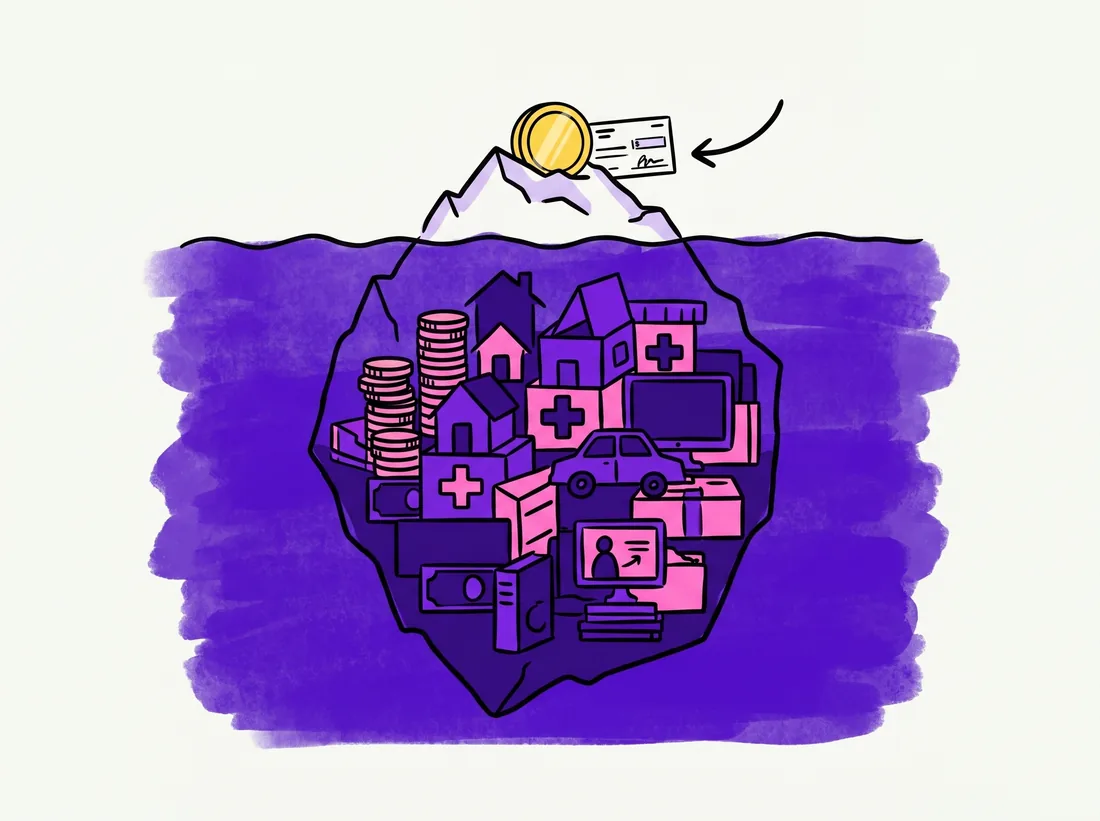
Base salary is less than half the true cost of an employed SDR. The sticker number ignores commission, payroll taxes, benefits, the outbound tool stack, the management time to run the rep, and the recruiting cost to hire them in the first place. It also ignores the two things that quietly destroy in-house outbound economics: ramp time and turnover.
So there are really only two questions worth answering. First, the fully-loaded cost of each path. Second, the risk-adjusted output, meaning the meetings that actually show up on your calendar after you account for the months a new rep is still learning and the odds they leave within eighteen months. Let's take them in order.
What an in-house SDR really costs
Start with cash compensation. In the United States in 2026, the median SDR base salary is about $60,000 and median on-target earnings (OTE) are about $85,000, according to RepVue's salary data. Top performers can clear $130,000. But there is a catch buried in that OTE figure: only about 53% of SDRs actually hit quota, so a chunk of that commission is budgeted but the results behind it are not guaranteed.
Then layer on everything that turns a salary into an employee. Payroll taxes and benefits typically add 25% to 40% on top of cash compensation. A real outbound motion needs tools: prospect data, a sending and sequencing platform, email warmup, extra domains and inboxes, and a CRM seat. And a rep needs a manager, or at least a slice of one. Here is what that looks like fully loaded for a single rep:
| Cost component | Annual cost (US, 2026) |
|---|---|
| Base salary | $55,000 - $65,000 |
| On-target commission / variable | $20,000 - $30,000 |
| Payroll taxes + benefits (~30%) | $22,000 - $32,000 |
| Outbound tool stack (data, sending, warmup, CRM) | $8,000 - $18,000 |
| Management + enablement (share of a leader) | $12,000 - $25,000 |
| Recruiting + onboarding (amortized) | $5,000 - $10,000 |
| Total, fully loaded | ~$120,000 - $180,000 / yr |
What a cold email agency actually costs (and what's included)
Most done-for-you cold email agencies charge $3,000 to $7,000 a month, with some enterprise engagements running to $12,000. Crucially, that fee is usually month-to-month or a short commitment, not a one-to-two-year employment bet. And you are not buying a person. You are buying a system and a team: data, copywriting, sending infrastructure, deliverability, reply handling, reporting, and the people who run all of it.
Ken's model is deliberately transparent. It is a flat $2,500 monthly retainer plus a per-contact fee that drops as you scale, starting at $100 per 1,000 contacts and falling to $70 per 1,000 at high volume. A typical engagement of 10,000 contacts a month works out to $3,500 a month, and that covers up to 50,000 emails, five campaigns, twenty sending domains, and a thousand warmed inboxes, with the full stack and team included. There is no setup fee, you can pause or cancel anytime, and the first campaign is usually live in about two weeks. The full breakdown is public on our pricing page at getken.ai/pricing.
The reason the fee looks small next to a headcount is that it replaces a whole list of line items you would otherwise own and operate yourself:
- Prospect data + enrichment - instead of ZoomInfo, Apollo, or Clay subscriptions ($6,000 to $40,000+/yr).
- Copywriting + frameworks - instead of an SDR's time, or a separate copywriter.
- Sending infrastructure (domains, inboxes, dedicated IPs) - instead of buying, configuring, and warming it yourself.
- Deliverability monitoring + fixes - instead of it becoming your problem at 2am.
- Reply handling + sentiment tagging - instead of burning SDR hours on out-of-office and wrong-person replies.
- Reporting + iteration - instead of manager time spent building dashboards.
- A trained team from day one - instead of a three-month ramp per hire.

Side-by-side: four ways to run cold outbound
In-house versus agency is the headline, but it is really a four-way choice. Founders also weigh running a do-it-yourself tool stack themselves, or handing the job to an AI SDR tool that automates prospecting and sending. Each has a different cost structure, speed, and risk profile.
Keep one thing in mind as you read the table: all four are just different ways to buy the same outcome, booked meetings. A DIY tool makes you the operator. A single hire makes you the manager and the deliverability desk. An AI SDR automates the sending but leaves quality and your domain reputation to chance. A managed service is the only path where someone else owns the machinery and you simply review the results. Here is the honest summary:
| Model | Cost & time to results |
|---|---|
| In-house SDR | $120k - $180k/yr per rep; ~3-month ramp; 50% annual turnover |
| DIY tool stack (you operate it) | $500 - $2,000/mo in tools plus your hours; weeks to set up; you own deliverability |
| AI SDR software | $1,000 - $5,000/mo; fast to start; unsupervised and generic, and it puts your domain at risk |
| Done-for-you agency (e.g., Ken) | $3,000 - $7,000/mo all-in; live in ~2 weeks; no hiring or turnover risk |
Cost per meeting: the number that actually matters
Total cost is only half the picture. What you really care about is cost per booked meeting, and that is where the comparison gets decisive.
A fully-ramped in-house SDR books somewhere around 10 to 15 meetings a month at steady state. But the year-one average is dragged down by the three-month ramp and the real chance the rep churns. At $120,000 to $180,000 fully loaded and, say, 10 meetings a month once ramped, that is roughly $1,000 to $1,500 per meeting in a good year, and meaningfully higher in year one.
Ken's published averages run the other way: a 3% reply rate versus the ~0.8% industry norm, a 16% click rate, 30% of replies positive, and about 7 booked meetings per 10,000 contacts, which is 7x the industry average of one. At the $3,500-a-month, 10,000-contact tier, that is roughly $500 per meeting, and it falls as volume rises and the flat retainer amortizes across more contacts.
To be clear about the assumptions: these are averages, your numbers will vary with your market and offer, and a strong in-house rep selling a high-ACV product can be worth far more than they cost. The point is not that in-house is bad. It is that a managed service tends to deliver a lower cost per meeting, sooner, without the ramp and turnover drag.
| Path | Rough cost per booked meeting |
|---|---|
| In-house SDR (steady state, ramped) | ~$1,000 - $1,500 |
| In-house SDR (year one, ramp-adjusted) | $2,000+ |
| Done-for-you agency, 10k contacts/mo | ~$500 |
| Done-for-you agency, 25k contacts/mo | ~$270 |
When in-house wins, and when it doesn't
This is not a case that you should never hire SDRs. There are clear situations where an in-house team is the right call, and pretending otherwise would be dishonest.
Hire in-house when outbound is a permanent, core growth engine you are committed to for years; when you can fund a real team rather than a single rep, so turnover does not zero out your pipeline; when your product is complex enough that the rep needs deep technical fluency to hold a conversation; and when you want total control over data, messaging, and process and are prepared to own deliverability and infrastructure yourself.
Hire an agency when you want pipeline in weeks rather than quarters; when you do not want to recruit, train, and replace people; when you would rather not become a deliverability expert; when you want to validate that outbound works for your offer before committing headcount; or when you want senior strategy and proprietary infrastructure without paying senior salaries to get them.
The most common smart move is a sequence, not a fork. Many teams start with an agency to prove the motion, learn what messaging and segments work, and build a playbook, then bring it in-house once the volume and economics clearly justify a full team. If you are still deciding whether to outsource at all, our complete guide to choosing a cold email agency at getken.ai/blog/cold-email-agency walks through the rest of the decision.
How Ken runs it
Ken AI is a done-for-you cold email service built around four pillars, so you get the output of a full outbound team without hiring one. Data: a 300M+ contact database plus AI qualification on subjective criteria no standard filter can touch. Messaging: human copywriters build the frameworks, and AI personalizes each email from a prospect's real profile and website. Infrastructure: our own SMTP servers on dedicated IPs, a replicated Gmail spam algorithm that pre-checks and rewrites every email, plus alternative domains and premium warmup that keep your primary domain safe. Iteration: every campaign is a test, with 10 to 50 running a month and feedback implemented in hours.
The results are the reason teams stay: more than 10 million emails sent in 2025, 40+ B2B clients, and averages of a 4x reply rate and 7x more meetings than the industry norm. Ryan Allis, founder of SaaSRise, went from roughly 260 to 370 paying members and says any B2B firm with an ACV north of $2,000 should be doing outbound, and that if you outsource it, Ken AI is a very good option. You can see the full stack at getken.ai/features and the founder's story at getken.ai/about.
Frequently asked questions
Is it cheaper to hire a cold email agency or an in-house SDR? For most teams hiring their first one or two reps, an agency is cheaper. A fully-loaded in-house SDR runs $120,000 to $180,000 a year once you add commission, benefits, tools, and management, versus roughly $36,000 to $84,000 a year for a done-for-you agency. In-house economics improve once you have a full, tenured team, but a single rep almost never beats an agency on cost or speed.
How much does an in-house SDR really cost? The base salary, about $60,000 in the US in 2026, is less than half the true cost. Add on-target commission (~$25,000), payroll taxes and benefits (~30%), an outbound tool stack ($8,000 to $18,000 a year), a share of management, and recruiting, and one SDR costs $120,000 to $180,000 fully loaded.
How long does it take an SDR to ramp? About 3.2 months to full productivity, according to The Bridge Group, a figure that has barely moved since 2010. With average tenure at 1.4 years and 50% annual turnover, many teams re-hire and re-ramp before a rep has spent much time fully productive.
Can a cold email agency replace an SDR entirely? For the top-of-funnel job, building lists, writing and sending personalized cold email, managing deliverability, and booking meetings, yes. A done-for-you agency runs that whole motion for you. What it does not replace is the discovery call and the close; those still belong to your account executives.
When does hiring an in-house SDR make sense? When outbound is a permanent core channel, you can fund a full team rather than one rep, your product needs deep technical selling, and you want total control of data and messaging. Many teams use an agency first to prove the motion, then hire in-house once the volume justifies it.
See what done-for-you outbound would cost you
The honest version of this decision comes down to your stage. If outbound is a long-term core function and you can fund a whole team, in-house can absolutely work. If you want booked meetings in weeks without hiring, managing, and replacing reps, a done-for-you service is almost always cheaper and faster to results.
If you want to see the real numbers for your situation, book a 30-minute strategy call with Cristian at getken.ai. You will see the backend, the data, and the client cases closest to your ICP, and if it is not the right fit, we will tell you what else to try. Book a founder call at https://cal.com/cristian-frunze/demo.