
What Is Done-for-You Cold Email? (And How It Actually Works)
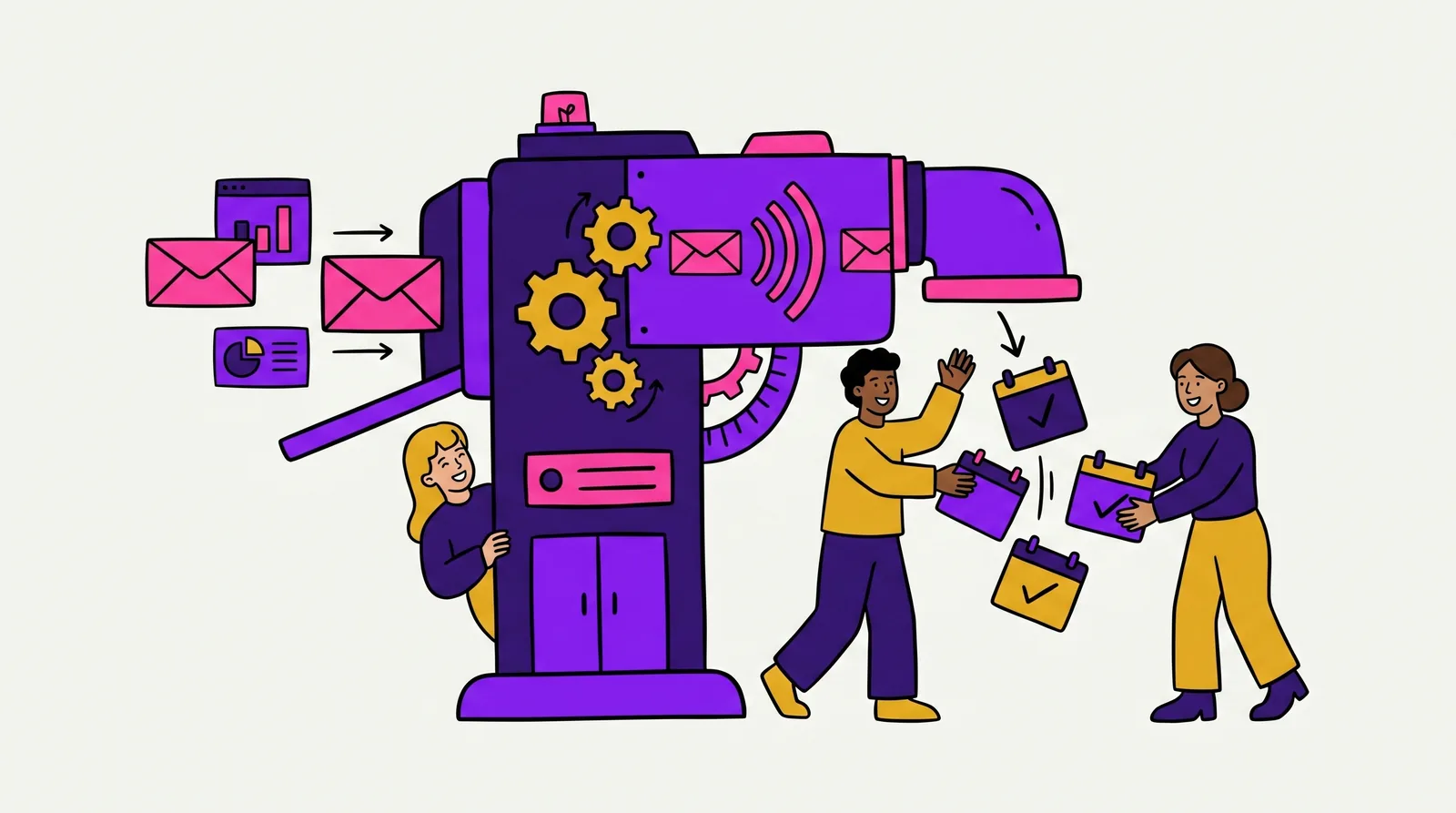
Done-for-you cold email is a fully managed service where an outside team runs your entire outbound email program for you - building and verifying your prospect list, writing and personalizing the copy, owning the sending infrastructure and deliverability, and handling the replies - and hands you booked meetings. You define your ideal customer and approve the work; the team does everything else.
The term gets used loosely, so this guide draws a clear line around what "done-for-you" actually means, what is included, how the process runs week by week, what it costs, and how it compares to running a tool yourself or hiring an SDR. We run Ken AI, a done-for-you cold email service, so we will use our own setup as a concrete example of what good looks like - and we will be honest about who this model is wrong for.
What "done-for-you" actually means
"Done-for-you" describes how much of the work the provider takes off your plate. Cold email help falls on a spectrum, and where a provider sits on it determines how much of your team's time the program still costs you.
- DIY tools (do-it-yourself). You buy software - a sender like Instantly or Smartlead, a data tool like Clay or Apollo - and you run everything: list building, copy, deliverability, sending, and replies. The software is cheap; your time is not.
- Done-with-you (coaching or hybrid). A consultant or platform advises you, sets some pieces up, and then hands you the controls. You still own the day-to-day execution.
- Done-for-you (fully managed). An outside team owns the entire motion end to end - strategy, data, infrastructure, copy, sending, deliverability, and reply handling - and reports results back to you. Your only jobs are defining the target and approving the work.
The line that separates real done-for-you
This article is about the third model. A true done-for-you service is not a dashboard with a support chat attached; it is a team plus the infrastructure to run outbound at a level most companies cannot build in-house. If a provider hands you a login and expects you to manage campaigns, that is a tool with onboarding - not done-for-you. The simplest test: after kickoff, how many hours a week does the program take from your team? Real done-for-you answers in single digits.
What is included in a done-for-you cold email service
A complete done-for-you service covers six functions. Most of the work is invisible to you by design, which is the entire point of paying for it. Here is what is happening under the hood, with what we run at Ken as a reference at each step:
- List building and qualification. It starts with a precise ideal customer profile, ideally split into several segments rather than one broad audience. Good services source matches from a large, multi-source database (we use 300M+ contacts across 20+ platforms), qualify on subjective criteria no standard filter can handle - like B2B SaaS with pricing above $3k - and triple-verify every address, filtering out roughly 78% of risky or invalid emails before a single send.
- Sending infrastructure. Top services do not send from your primary domain or from shared tool infrastructure. They set up alternative sending domains that mirror your brand, configure authentication (SPF, DKIM, DMARC), and send from inboxes they control. We run our own email servers on dedicated IPs rather than Gmail or Outlook.
- Deliverability management. New domains and inboxes are warmed for a couple of weeks before real sending, then monitored continuously with tools like Microsoft SNDS and Google Postmaster. We also run every message through a replicated Gmail spam algorithm that rewrites anything likely to be filtered, which is how we hold 80%+ inbox placement while most senders struggle to clear 50%.
- Copywriting and personalization. Human copywriters build the frameworks and angles; AI is trained to replicate that voice for each prospect, referencing real details from their world instead of swapping a first-name variable. A CFO should get a genuinely different email than a Head of Sales.
- Sending and optimization. Campaigns send at controlled volumes across warmed inboxes, with multiple angles tested in parallel. Winners get more volume; losers get rewritten or cut.
- Reply handling and meeting booking. Replies are triaged - genuine interest is qualified and booked onto your calendar, while out-of-office and not-interested are filtered out. You get warm conversations, not a raw inbox to sort.

How done-for-you cold email works, step by step
The managed model follows a predictable path. Here is how it runs in practice, using Ken's timeline as an example of how fast a well-run service moves:
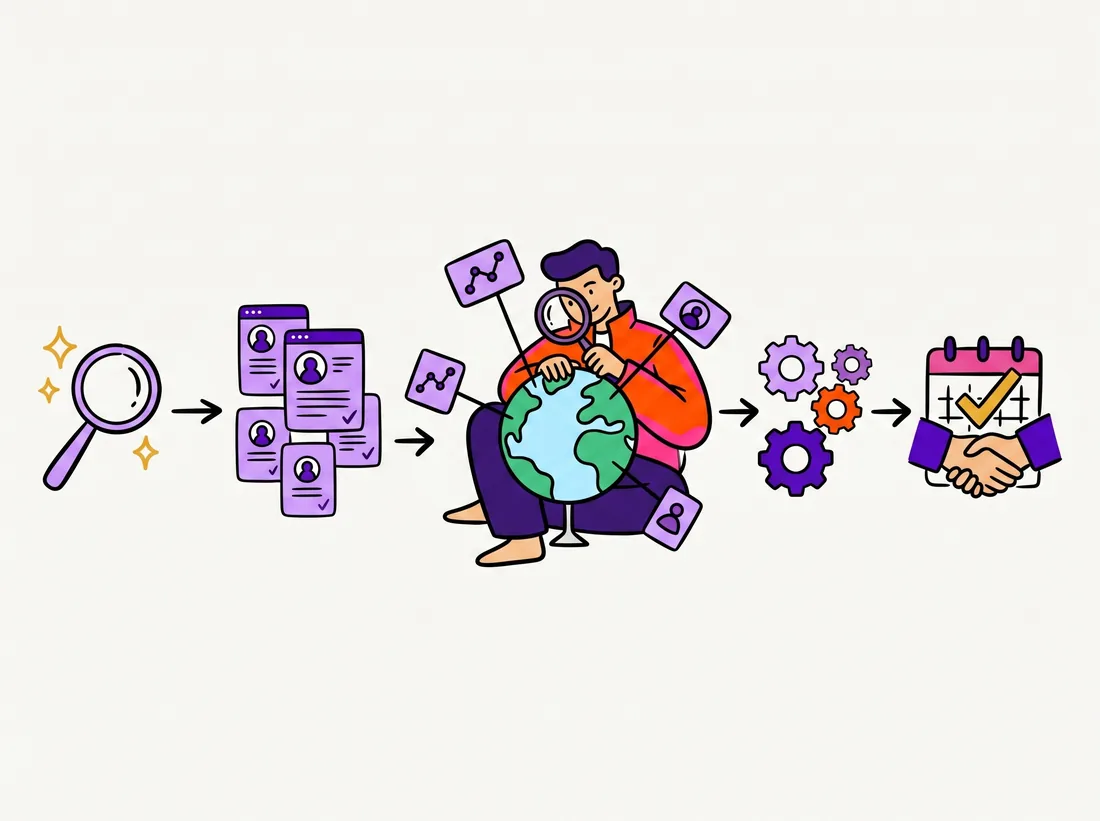
- Strategy and onboarding (week one). You map your ideal customer profile, offer, and goals on a kickoff call. The team builds the go-to-market strategy and starts warming sending domains in the background.
- Targeting and sourcing. Your ICP is segmented into audiences; prospects are sourced from a large database, qualified against the criteria that define a real buyer, and triple-verified.
- Copy and launch (week two). Copywriters write per-segment frameworks; AI personalizes each email in your voice; you approve, and the first campaigns go live about two weeks from kickoff.
- Send, monitor, and optimize. Email sends from dedicated infrastructure through a deliverability pre-check; performance is monitored and copy is continuously tested across segments.
- Warm conversations delivered. Interested replies are qualified and booked, and engaged clickers can feed your retargeting audiences. You get booked meetings, not a to-do list.
What you provide vs. what the service handles
One reason teams choose done-for-you is how little it asks of them. The split is simple:
| You provide | The service handles |
|---|---|
| Your ideal customer profile and offer | Segmenting the ICP and sourcing matching prospects |
| Approval on copy and target lists | Writing, personalizing, and A/B testing every email |
| Calendar access for booked meetings | All sending infrastructure, domains, and warmup |
| Feedback on what is working | Deliverability monitoring and inbox placement |
| Any existing lists you want enriched | Reply triage, qualification, and meeting booking |
Done-for-you vs. DIY tools vs. hiring an SDR
If you are weighing done-for-you against the alternatives, the honest trade-offs look like this. Tools are cheapest on paper and most expensive in practice, because the hidden cost is a skilled person running them 15 to 25 hours a week. Hiring an SDR only makes sense if you are committed to building the function in-house.
| Option | What you are really signing up for |
|---|---|
| DIY tools (Instantly, Smartlead, Clay) | Cheap software, but you become the integrator, copywriter, deliverability engineer, and analyst - most teams plateau near a 1% reply rate. |
| AI SDR | Scales sending with no human owning quality, so it tends to produce the generic mail that gets filtered and ignored. |
| In-house SDR | $8k to $12k+ a month fully loaded, two to four months to ramp, and learning deliverability on your own domain. |
| Done-for-you service | A managed team plus owned infrastructure that delivers booked meetings in about two weeks. You approve; they run it. |
What does done-for-you cold email cost?
Pricing falls into four common models: a flat monthly retainer, a per-prospect or per-contact fee, pay-per-meeting, or a performance-linked hybrid that pairs a base fee with results-based pricing. Across the market, fully managed programs commonly run anywhere from about $2,000 to $8,000 a month depending on volume and scope.
At Ken, we use a performance-linked hybrid: a flat retainer of about $2,500 a month plus a per-contact fee that scales down as you grow, from roughly $100 to $70 per 1,000 contacts. A representative $3,500 a month plan covers around 10,000 contacts, 50,000 emails, 5 campaigns, 20 sending domains, and up to 1,000 inboxes - with the entire software stack and the team included, no setup fee, and no lock-in. Exact plans are on our pricing page.
Loaded honestly, the do-it-yourself routes often cost more than they look. A data-and-enrichment pipeline through a tool like Clay can run roughly $0.55 per contactable lead for the data work alone - before a sending tool or the person operating it - and an in-house SDR runs $100k+ a year. A managed service folds the tools, the infrastructure, and the team into one number, and at scale the all-in cost per contact drops into the low tens of cents. Pricing here is current as of 2026; confirm specifics with any provider you evaluate.
What good results look like
Set expectations with real benchmarks. Industry-wide, cold email reply rates typically land somewhere around 1 to 5%, and the gap between a list-and-pray stack and a well-run managed program is large. A few realities hold no matter who you hire: it is a medium-term channel, list and copy quality beat raw volume every time, and positive-reply rate - genuine interest, not just any response - is the number that matters most.
As a real-world reference, here is what we report at Ken across 10M+ emails sent in 2025 for 40+ B2B companies:
- 4x the reply rate and 7x more meetings than the industry average
- A 3% reply rate with a 30% positive-reply rate (genuine interest, not just any response)
- A 16% click rate and roughly 7 booked meetings per 10,000 contacts
- 80%+ inbox placement, versus the sub-50% many senders see
Who done-for-you cold email is for (and who it is not)
Done-for-you is the right call when you do not have in-house outbound expertise, you want pipeline without hiring and ramping a team, deliverability feels like a black box, or your team's time is better spent closing than prospecting. It fits B2B companies with a clear ideal customer and an average contract value high enough to support a sales-led motion. As one of our clients, Ryan Allis, founder of SaasRise and a $169M SaaS exit, puts it: any B2B firm with an ACV north of $2k should be doing outbound email, and if you are going to outsource it, Ken AI is a very good option.
It is probably not the right fit when you are pre-product-market-fit with no clear ICP, your contract value is too low to justify a sales-led channel, or you are committed to building an in-house SDR function for the long haul. A good service will tell you when that is the case rather than take the engagement. For the deeper version of this decision - including how to choose a provider and the exact questions to ask - see our complete cold email agency guide.
Frequently asked questions
What is the difference between done-for-you and done-with-you cold email? Done-for-you means a team runs the entire program and hands you booked meetings; you only define the target and approve the work. Done-with-you means you get advice, templates, or partial setup but still run the day-to-day execution yourself. Done-for-you costs more and takes far less of your time.
How much does done-for-you cold email cost? Fully managed programs commonly run about $2,000 to $8,000 a month depending on volume. At Ken, for example, it is roughly a $2,500 monthly retainer plus a per-contact fee starting near $100 per 1,000 contacts that drops as you scale, with the software stack and team included and no setup fee.
Is done-for-you better than doing cold email myself? It depends on your time and expertise. A tool is cheaper on paper, but running it well takes 15 to 25 hours a week of a skilled operator. If you have that person and want full control, DIY can work; if you want booked meetings without managing infrastructure and deliverability, done-for-you is usually the better economics.
Do I need to buy other tools if I hire a done-for-you service? No. A true done-for-you service includes the entire stack - data, sending infrastructure, deliverability tooling, and analytics. Not having to assemble and pay for tools separately is a core reason it can cost less than doing it yourself.
How fast will I see results? Expect your first campaign live in about two weeks, with first replies shortly after and momentum building over two to three months. Cold email is a compounding, medium-term channel, not an overnight one.
Is cold email still legal in 2026? Yes. B2B cold email is legal in the US under the CAN-SPAM Act, and compliant outreach also respects CASL in Canada, GDPR in the EU and UK, and CCPA in California: accurate headers, honest subject lines, a valid physical address, and an honored opt-out are the basics. This is general information, not legal advice.
See done-for-you cold email in action
If you want booked meetings without operating the machine, that is exactly what done-for-you means - and what we do at Ken. Book a 30-minute founder call with Cristian and you will see the backend, the real data, and the campaigns closest to your ICP. If it is not the right fit, we will tell you what else to try. You can grab a time at cal.com/cristian-frunze/demo.
Want to dig in first? See how the system works on our Why Ken page, the full breakdown on Features, and exact plans on Pricing at getken.ai.